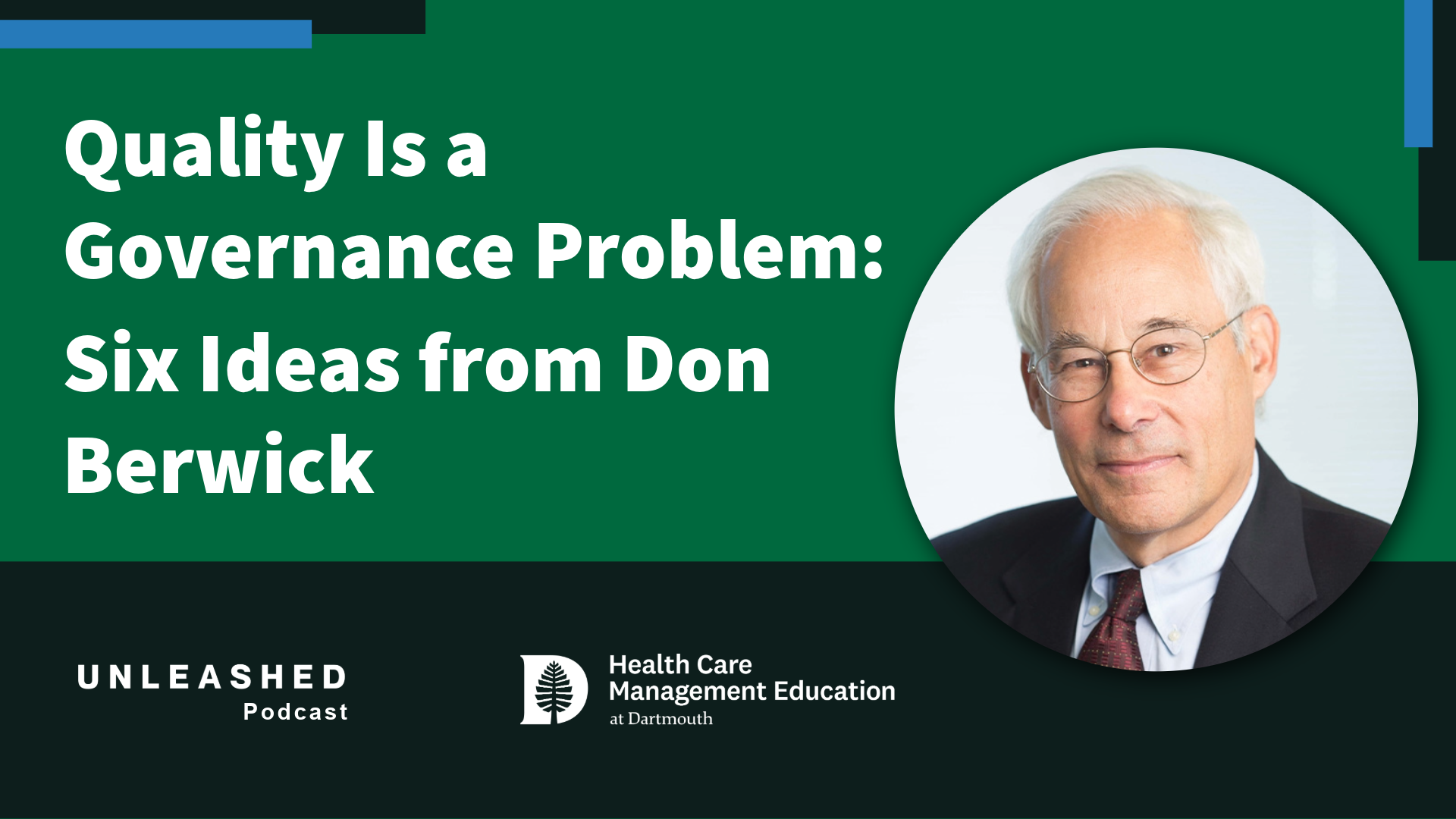
Quality Is a Governance Problem: Six Ideas from Don Berwick
Insights from Episodes 23 and 27 of the Unleashed: Redesigning Health Care podcast.
10/22/2026
Don Berwick, co-founder of the Institute for Healthcare Improvement and former head of the Centers for Medicare & Medicaid Services, has spent decades on one question: why does health care improve more slowly than it could?
In the first of two episodes on the Unleashed podcast, he looked back on IHI’s 100,000 Lives Campaign, when 3,300 hospitals signed up within six months to adopt quality improvement initiatives. Building upon that conversation, the second episode addresses hospital governance and how the broader system is designed. Berwick makes the case that quality is a leadership and structure problem more than a technical one.
1. Know-how is not the bottleneck
The methods for improving quality, such as plan-do-study-act cycles and audits, have been around for decades and are teachable, but Berwick argues that this project-by-project improvement, while valuable, is not transformative. Rather, what transforms an organization is when the board, executives, and professional leaders declare that excellence in the work is the main goal. As co-host Chris Trimble expresses, thousands of small steps only happen when improvement is an enduring priority.
2. The people on the board set the priorities
Berwick describes a study of hospital boards, overseen by two of his Harvard medical students, that examined 15 health systems. In the 10 organizations with enough information to assess, slightly fewer than 15 percent of board members had worked in care delivery. He states that his ideal board composition is a majority of people with lived experience as patients, plus clinicians and physicians from across the workforce. His answer to the objection “what do patients know?” is to try it.
If an organization focuses on the needs of the people it serves, business success follows, Berwick argues. Contrasting health care with other industries which work to remove activity that adds no value, hospitals tend to cut budgets and staff with blunt measures. Financial success should support the mission, not be the mission, and that board incentives should be tied to the experience of patients, families, and communities rather than the bottom line. Measurement, he adds, should follow a deeper commitment to purpose and to understanding what is happening in the organization.
A long-standing belief that patient control leads to bad decisions and excessive treatment has historically limited the amount of power a patient has in their own care. Berwick challenges this belief, in fact, saying that we must empower patients to take a much more involved role in their care. He also describes moral injury, which arises when clinicians work in environments whose aims conflict with what’s in their hearts. Co-host Glyn Elwyn notes emerging evidence that clinicians who involve patients more in decisions feel more fulfilled and are at lower risk of burnout.
5. Payment design can undermine all of it
Berwick has little faith left in the phrase “value-based care,” which he calls word salad, believing that incumbents bend the language to mean “pay me more.” Trimble points out that because payment follows government-defined billing codes, a better service that isn’t on the list can earn nothing. Berwick favors population-based payment to nonprofit organizations responsible for the health of a defined population, drawing on examples from the UK and Singapore, and he considers strong primary care a feature of every successful system he studies.
6. AI can help, but it won’t restructure anything
Berwick sees ambient listening as a clear win that will contribute towards better clinician attention and better records. He is hopeful about AI as a background coordinator that makes sure the right people learn something at the right time, also citing its potential in diagnosis and patient-facing tools. Trimble offered a limit: AI cannot change the payment model, reorganize health care, or put more patients and clinicians on boards.
Find Berwick’s episodes and many other insightful conversations on unleashedpodcast.org, Spotify, or Apple Podcasts.
Unleashed: Redesigning Health Care is a podcast hosted by Glyn Elwyn and Chris Trimble that spotlights clinicians reinventing care delivery. Produced in affiliation with Health Care Management Education at Dartmouth, it's sponsored by The Dartmouth Institute for Health Policy & Clinical Practice and EBSCO Clinical Decisions.
Health Care Management Education at Dartmouth is a joint venture between the Tuck School of Business and Geisel School of Medicine which delivers the Master of Health Care Delivery Science (MHCDS) and Master of Health Administration (MHA) programs.

